Distribuer une app mobile en 2025 : native, PWA, stores alternatifs
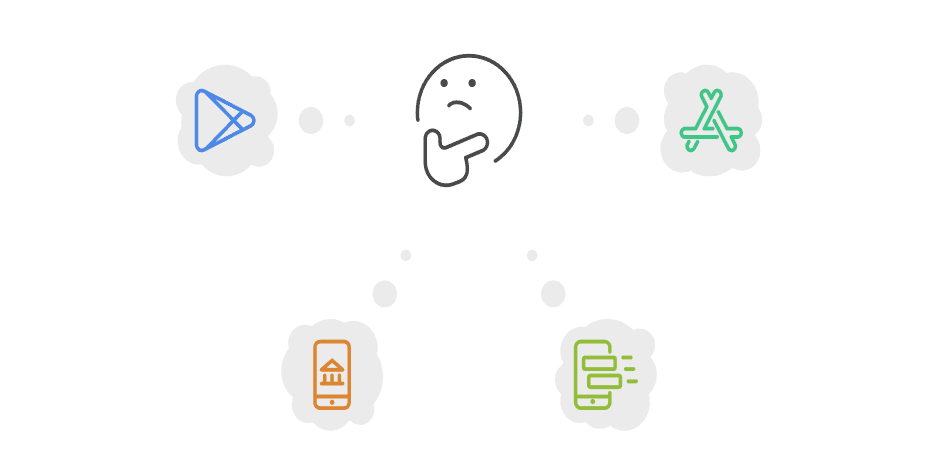
Voulez-vous distribuer votre application mobile ? Découvrez les différentes options disponibles : App Store, Google Play, boutiques alternatives, chargement latéral et applications Web progressives (PWA). Chaque méthode présente ses avantages et ses inconvénients en termes de visibilité, de coûts et de restrictions. Dans cet article, nous détaillons les meilleures stratégies de distribution pour maximiser votre audience et optimiser l’expérience utilisateur.
La distribution d’une application mobile dépend de plusieurs facteurs : le type d’application (native, hybride ou web complet), l’audience cible et les objectifs commerciaux. Voici les principales méthodes de distribution :
1. Distribution via les magasins officiels (App Store et Google Play)
Pour les applications natives et hybrides
Les magasins Apple (App Store) et Google (Google Play) sont les canaux les plus courants et offrent une large visibilité.
Avantages :
- Accès direct à des millions d’utilisateurs.
- Systèmes de paiement intégrés (Apple Pay, Google Pay, abonnements dans l’application).
- Sécurité et confiance des utilisateurs.
- Mises à jour automatiques et notifications push.
Inconvénients :
- Validation stricte (surtout chez Apple).
- Commissions sur les ventes (généralement 30 %, réduites à 15 % sous certaines conditions).
- Dépendance aux règles des magasins.
Variantes :
- App Clips (iOS) / Instant Apps (Android) : Permet d’utiliser une partie de l’application sans installation complète.
- TestFlight (iOS) / Google Play Beta Testing : Pour distribuer des versions bêta avant la sortie.
2. Distribution via des magasins alternatifs
Pour Android uniquement (officiellement)
En dehors de Google Play, plusieurs plateformes permettent de distribuer des applications Android :
- Amazon Appstore (utilisé principalement pour les appareils Fire).
- Samsung Galaxy Store (pour les appareils Samsung).
- Huawei AppGallery (alternative après l’embargo américain).
- APKPure, Aptoide (moins régulés mais parfois risqués).
Avantages :
- Moins de restrictions qu’Apple et Google Play.
- Frais réduits ou inexistants.
- Opportunités de monétisation alternatives.
Inconvénients :
- Moins de visibilité et de trafic utilisateur.
- Risque de sécurité (magasins d’applications moins contrôlés).
- Nécessite parfois des intégrations spécifiques.
3. Distribution directe via un site web (Sideloading)
Principalement pour Android, plus compliqué sur iOS
Les développeurs peuvent offrir le téléchargement direct d’un fichier APK (Android Package) sur leur site web.
Avantages :
- Pas de commission sur les ventes.
- Contrôle total de la distribution.
- Possibilité de mettre à jour sans dépendre des magasins.
Inconvénients :
- Moins de visibilité qu’avec les magasins.
- Problèmes de sécurité (nécessite d’activer « sources inconnues » sur Android).
- Plus difficile d’établir la confiance des utilisateurs.
Cas spécifique : iOS
- Impossible de proposer un téléchargement direct d’une application iOS (IPA) sans passer par l’App Store, sauf via des certificats d’entreprise (voir section suivante).
4. Distribution via le programme d’entreprise (B2B - iOS & Android)
Pour les applications internes d’entreprise
- Programme d’entreprise des développeurs Apple : Permet la distribution d’une application sans passer par l’App Store, mais uniquement aux employés d’une entreprise.
- Magasin Google Play géré : Permet aux entreprises de distribuer des applications privées à leurs employés via un Google Workspace.
Avantages :
- Pas besoin de validation de l’App Store.
- Idéal pour les applications internes d’entreprise.
Inconvénients :
- Processus d’approbation strict chez Apple.
- Risque de révocation de certificat si Apple détecte un abus (par exemple, une distribution publique déguisée).
5. Application Web Progressive (PWA) : L’alternative web complète
Pour les applications accessibles directement via un navigateur
Une PWA (Application Web Progressive) est une application web qui fonctionne comme une application native :
- Installation sur l’écran d’accueil.
- Fonctionnalités hors ligne.
- Notifications push (support limité sur iOS).
Avantages :
- Pas besoin de validation par Apple ou Google.
- Déploiement instantané, pas besoin de mises à jour via un magasin.
- Fonctionne sur tous les systèmes d’exploitation (Android, iOS, bureau).
Inconvénients :
- Accès limité au matériel du téléphone (Bluetooth, capteurs avancés…).
- Moins de visibilité qu’une application native.
- Expérience parfois inférieure à celle des applications natives.
Limitation majeure sur iOS : Apple restreint certaines fonctionnalités des PWA (par exemple, pas de notifications push sur iOS avant iOS 16.4).
Conclusion : Quelle méthode choisir ?
- Grand public ? → Magasins officiels (App Store, Google Play).
- Marché Android de niche ? → Magasins alternatifs ou APK direct.
- Entreprise interne ? → Programme d’entreprise.
- Rapidité et flexibilité ? → PWA.
Si possible, combinez plusieurs approches !
Exemple : une PWA pour le web + une application native sur les magasins pour atteindre le maximum d’utilisateurs.