Splatting Gaussien : révolutionner la visualisation 3D
Introduction : Une nouvelle ère dans le rendu 3D
Le Gaussian Splatting représente une avancée fondamentale dans le rendu d’environnements 3D photoréalistes, permettant tout, des expériences immersives de réalité virtuelle aux jumeaux numériques pratiques qui permettent des visites à distance sans déplacement physique.
Qu’est-ce que le Gaussian Splatting ?
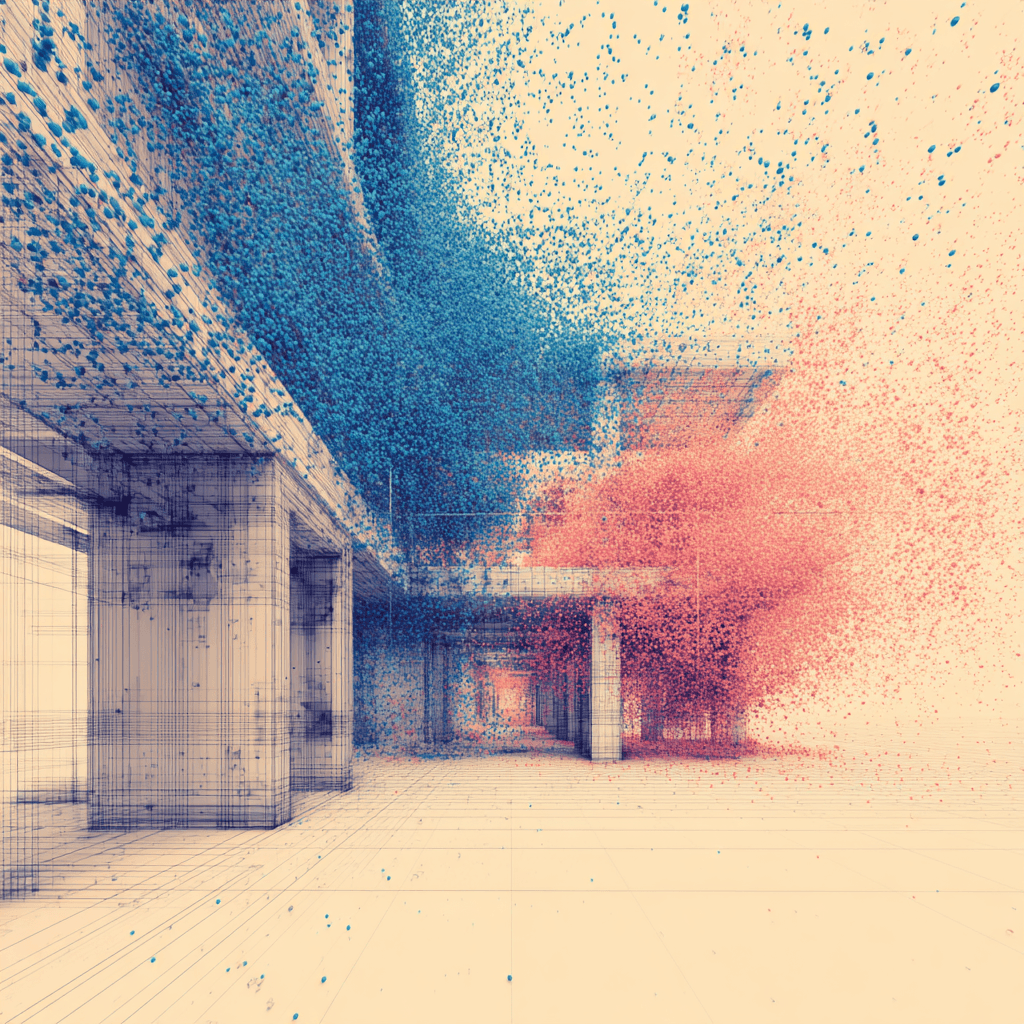
Dans son essence, le Gaussian Splatting est une technique innovante de reconstruction 3D qui représente des scènes à l’aide de millions de petites fonctions gaussiennes 3D—essentiellement, des éléments semblables à des points avec des informations de couleur, de position et d’orientation. Contrairement à la modélisation 3D traditionnelle qui repose sur des maillages et des textures, ou même des Neural Radiance Fields (NeRF) qui nécessitent des calculs intensifs de réseaux neuronaux, le Gaussian Splatting offre un terrain d’entente unique : une qualité photoréaliste avec des capacités de rendu en temps réel. Pour une explication visuelle et pas à pas de son fonctionnement, voir Qu’est-ce que le Gaussian splatting ?
Pourquoi le Gaussian Splatting est important pour les entreprises et l’industrie
Des jumeaux numériques sans complexité
Les jumeaux numériques—répliques virtuelles d’actifs physiques, de processus ou d’environnements—ont longtemps promis de révolutionner la manière dont les organisations gèrent et optimisent leurs opérations. Avec cette technologie, les entreprises peuvent capturer rapidement et de manière rentable des représentations 3D complètes d’installations, de chantiers de construction, d’espaces commerciaux ou d’usines.
Des expériences de réalité virtuelle immersives qui tiennent réellement leurs promesses
La réalité virtuelle a lutté avec le défi du photoréalisme par rapport à la performance. Le Gaussian Splatting résout cela en offrant une qualité photoréaliste qui fonctionne de manière fluide dans les casques VR, créant ainsi de véritables expériences immersives qui estompent la frontière entre le virtuel et le réel.
Démocratisation par l’accessibilité
Peut-être l’aspect le plus excitant du Gaussian Splatting est son accessibilité rapide à un public plus large. Ce qui nécessitait autrefois des équipements spécialisés, une expertise technique et un investissement significatif peut désormais être accompli avec un smartphone et le bon logiciel.
L’écosystème du Gaussian Splatting : Naviguer parmi vos options
La maturation rapide du Gaussian Splatting a engendré un écosystème diversifié d’outils répondant à différents besoins, budgets et capacités techniques.
Solutions professionnelles et d’entreprise
PostShot représente le haut de gamme du marché, offrant une qualité de rendu exceptionnelle par le biais d’un modèle d’abonnement. Pour les entreprises qui privilégient la fidélité visuelle et les résultats professionnels, PostShot fournit le polissage nécessaire pour des applications avec les clients et des présentations à enjeux élevés.
Volinga cible les marchés professionnels des VFX et de la production virtuelle, où la combinaison de qualité et de performance en temps réel du Gaussian Splatting en fait une solution idéale pour les projets de films, de télévision et de visualisation avancée.
Varjo Teleport utilise le traitement basé sur le cloud pour délivrer une reconstruction 3D photoréaliste spécifiquement optimisée pour les applications VR, ce qui la rend particulièrement attrayante pour les entreprises déjà investies dans l’écosystème matériel VR premium de Varjo.
Options open-source et conviviales pour les développeurs
La communauté open-source a embrassé le Gaussian Splatting avec enthousiasme, produisant plusieurs implémentations matures.
LichtFeld Studio se distingue par ses temps d’entraînement rapides et son soutien communautaire actif, ce qui le rend accessible aux développeurs et aux petites organisations.
GSplat propose une implantation mature et bien documentée qui est particulièrement facile à automatiser et à intégrer dans des flux de travail existants.
NerfStudio adopte une approche modulaire, prenant en charge à la fois le Gaussian Splatting et les Neural Radiance Fields au sein d’une seule plateforme.
SuperSplat fournit un éditeur gratuit basé sur le navigateur pour inspecter et optimiser les Gaussian Splats, abaissant la barrière à l’entrée.
Solutions mobiles : capture 3D dans votre poche
La démocratisation de la capture 3D a progressé de manière spectaculaire avec des applications mobiles qui mettent les capacités de Gaussian Splatting à la disposition de tous.
Polycam offre des capacités de numérisation rapides avec un traitement basé sur le cloud, rendant la capture 3D de qualité professionnelle accessible aux utilisateurs sans expertise technique.
Scaniverse met l’accent sur la facilité d’utilisation avec son interface simple, fournissant des résultats de qualité moyenne qui suffisent pour de nombreuses applications pratiques.
Meta Horizon Hyperscape Capture exploite les capacités du Quest 3 pour permettre aux utilisateurs de scanner des espaces réels et de les explorer en VR photoréaliste directement dans l’écosystème de Meta.
Faire le bon choix : Un cadre stratégique
Avec tant d’options disponibles, comment choisir ?
Exigences de qualité
Différentes solutions produisent différents niveaux de qualité. Les applications professionnelles comme la visualisation architecturale, le marketing immobilier pour des propriétés de luxe, ou le travail VFX exigent la plus haute qualité, vous orientant vers des solutions comme PostShot, Volinga ou des outils open-source bien configurés comme GSplat.
Capacité technique
Soyez honnête sur vos ressources techniques. Les solutions open-source offrent de puissantes capacités et des avantages en termes de coûts mais nécessitent des compétences techniques, de la patience et souvent un investissement en temps significatif.
Exigences de traitement
Certaines solutions traitent localement sur votre appareil, d’autres utilisent le cloud computing, et certaines offrent les deux options. Le traitement cloud signifie que vous pouvez travailler depuis des appareils moins puissants mais nécessite une bonne connectivité Internet et implique souvent des coûts par scan.
Intégration dans le flux de travail
Considérez comment le Gaussian Splatting s’intègre dans votre flux de travail plus large. Avez-vous besoin d’exporter des modèles pour une utilisation dans des moteurs de jeux, des logiciels 3D ou des plateformes web ?
Échelle et volume
Créez-vous des présentations uniques ou traitez-vous des centaines d’espaces ? L’économie et la praticité changent radicalement à grande échelle.
Considérations budgétaires
La gamme va de complètement gratuite (outils open-source) à des services par abonnement (Polycam, PostShot) jusqu’à des solutions de niveau professionnel avec des coûts significatifs (Volinga, Varjo Teleport).
La révolution de l’accessibilité en pleine croissance
Ce qui rend ce moment particulièrement excitant, c’est la rapidité avec laquelle la technologie se démocratise. Il y a à peine quelques années, créer des représentations 3D photoréalistes nécessitait des équipements spécialisés en photogrammétrie, des clusters informatiques puissants et des connaissances expertes. Aujourd’hui, une personne avec un smartphone et un abonnement mensuel de 10 $ peut créer des captures 3D impressionnantes de son environnement en quelques minutes.
Cette accessibilité stimule l’innovation dans des directions inattendues. Les petits musées créent des expositions virtuelles. Les détaillants indépendants offrent des expériences de shopping immersives en ligne. Les enseignants documentent des sorties scolaires sous forme d’espaces 3D explorables. Les agents immobiliers dans les zones rurales rivalisent avec des entreprises des grandes villes grâce à des visites de propriétés virtuelles. Les familles conservent des souvenirs de maisons et d’espaces en trois dimensions.
Les outils continuent de s’améliorer à un rythme remarquable. Les temps de traitement diminuent, la qualité augmente, la taille des fichiers devient plus gérable, et les interfaces utilisateurs deviennent plus intuitives.
Conseils pratiques pour commencer
Pour les débutants complets : Commencez avec Scaniverse ou Polycam sur votre smartphone. Passez un après-midi à capturer quelques espaces pour comprendre le processus, les limitations et le potentiel.
Pour les petites entreprises : Le niveau d’abonnement de Polycam offre le meilleur équilibre entre qualité, facilité d’utilisation et abordabilité pour la plupart des applications commerciales pratiques.
Pour les équipes techniques : Expérimentez avec NerfStudio ou GSplat pour comprendre la technologie sous-jacente et obtenir un contrôle maximal.
Pour les productions professionnelles : Évaluez PostShot ou Volinga en fonction de vos exigences spécifiques.
Pour les projets axés sur la VR : Si vous êtes déjà dans l’écosystème Meta, commencez avec Horizon Hyperscape Capture pour comprendre les bases, puis évaluez Varjo Teleport si vous avez besoin de qualité supérieure ou de fonctionnalités professionnelles.
L’avenir du Gaussian Splatting
La technologie continue d’évoluer rapidement. Le développement actuel se concentre sur l’amélioration de la vitesse de capture, la réduction de la taille des fichiers, l’amélioration des capacités d’édition et la rendre plus accessible avec de meilleurs outils et flux de travail. L’intégration avec l’intelligence artificielle promet d’automatiser de nombreux aspects de l’optimisation et de l’amélioration des scènes, abaissant encore les barrières à l’adoption.
Avec la maturation des technologies réseau telles que la 5G et d’autres à venir, le streaming des expériences Gaussian Splat deviendra plus pratique, permettant une distribution de contenu 3D de haute qualité sans nécessiter que les utilisateurs téléchargent de gros fichiers.
La convergence du Gaussian Splatting avec d’autres technologies émergentes—la réalité augmentée, les plateformes de calcul spatial comme Apple Vision Pro, et la création de contenu pilotée par l’IA—suggère que nous ne faisons qu’effleurer son plein potentiel.
Conclusion : Adopter le futur 3D
Le Gaussian Splatting représente plus qu’une simple amélioration incrémentale des graphiques 3D—c’est un changement fondamental dans la manière dont nous capturons, représentons et expérimentons l’information spatiale. L’évolution rapide de la technologie et sa démocratisation signifient que les barrières à l’entrée baissent continuellement, rendant maintenant un excellent moment pour explorer son potentiel pour vos besoins spécifiques.
Bien que choisir le bon logiciel puisse être déroutant compte tenu de l’abondance d’options, cette abondance reflète la vitalité et l’applicabilité large de la technologie. Plutôt que de voir cela comme un problème, considérez cela comme une opportunité : il existe presque certainement une solution qui correspond à vos exigences spécifiques, à votre budget et à vos capacités techniques.
L’écosystème diversifié—des solutions professionnelles comme Volinga et PostShot aux applications mobiles accessibles comme Polycam et Scaniverse, et aux plateformes open-source puissantes comme GSplat et NerfStudio—assure que les organisations et les individus de toutes tailles peuvent trouver un point d’entrée approprié à leurs besoins.
Alors que nous avançons vers un avenir de plus en plus numérique où la collaboration à distance, les expériences virtuelles et les jumeaux numériques deviennent standards plutôt qu’exceptionnels, le Gaussian Splatting sera probablement reconnu comme l’une des technologies fondamentales qui a rendu cette transition possible. La question pour les organisations et créateurs à la recherche de l’avenir n’est pas de se demander s’ils doivent explorer cette technologie, mais comment tirer le meilleur parti de ses capacités pour leurs situations uniques.
L’avenir de la 3D est là, il devient plus accessible chaque jour, et il est rendu avec des Gaussian Splats.