
The robot that draws your floor plan: what Ring’s indoor drone says about mapping spaces
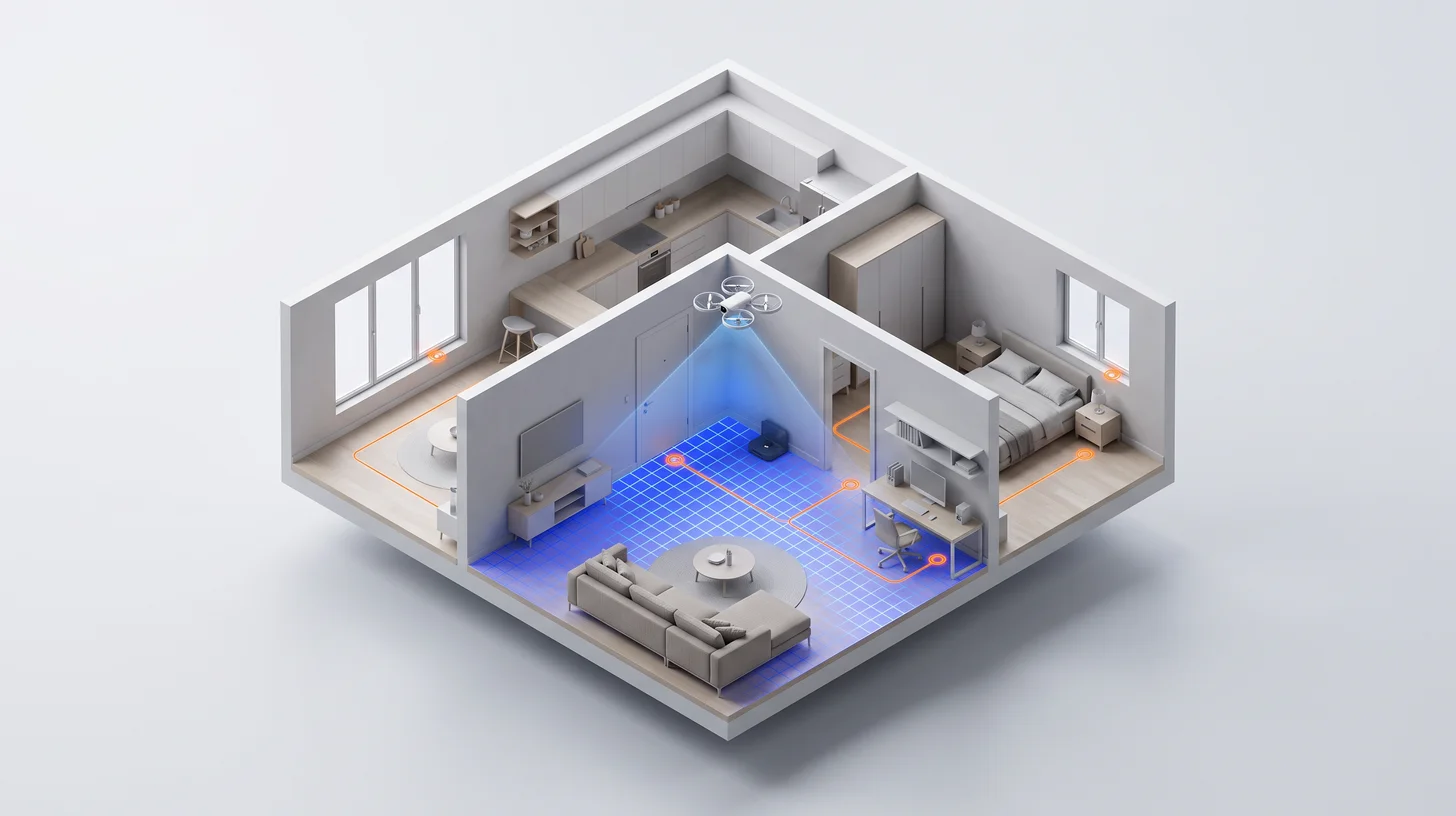
On 10 November 2026, Amazon launched Ring Robotics: a $249.99 indoor drone for homes and a $999.99 rolling robot for shops and offices. Both are security cameras that move. But before either of them watches anything, it does something more interesting: it draws a map. One walk through the place, and the robot knows its rooms, its doors, its windows, and the route it will take to check them.
That map is the real product. Ring’s founder Jamie Siminoff says customers wanted “eyes in the places a fixed camera couldn’t reach.” To get there, a camera has to understand space, which is exactly the building block that indoor navigation, augmented reality in stores and digital twins of venues are made of. Here is what Ring shipped, how a machine maps a room, what Amazon does not say about that map, and why it matters well beyond home security.
What Ring launched
The Ring Drone Cam is a 165 g indoor drone with a 2K camera and a 148° field of view. It sleeps in a dock with its camera off, takes off on demand, on a schedule, or when another Ring device is triggered, flies a patrol, then lands to recharge. It works on one floor, has no microphone, and is noisy on purpose: you hear it coming. Amazon plans to ship it in the US on 27 January 2027, but it has not yet been authorised by the US regulator, the FCC, and until it is, Amazon can only take sign-ups.
Ring’s launch film for the Drone Cam: it leaves its dock, checks the home and comes back.
Video: Ring, on YouTube.The Ring Rover Cam is the same idea on wheels, for businesses. It weighs 9.35 kg, films in up to 4K with a camera on a periscope mast, carries a siren, a light tower and two-way audio, and covers up to 5,000 sq ft on one floor. It ships in the US on 16 December 2026. It is, by Amazon’s own account, the Astro home robot repurposed.
The Rover Cam patrols a shop after closing, its periscope raised.
Video: Ring, on YouTube.Both run on what Amazon calls AI Pilot, and both need a Ring Protect subscription for scheduled patrols.
From one walk-through to a floor plan
Amazon describes AI Pilot in a few sentences. You carry the drone through your home once; the rover explores on its own. AI Pilot “turns what it sees into a floor plan,” identifies the rooms and suggests patrol points: a side door, the windows, the till, a long corridor. You can edit them or add your own. For each patrol, it plans an efficient route on that map and steers around furniture and shelves in real time.
How a robot turns one walk-through into a map
- Front door
- Living-room window
- Kitchen window
- Bedroom window
- Office desk
- Dock
- Walk-through. The drone is carried through the home once; the rover drives through on its own. Every camera view fills in the cells it sees.
- Rooms. The walls and furniture found during the walk become a floor plan, and each space gets a name.
- Patrol points. It proposes the places worth checking, here doors and windows; the owner can move them or add others.
- Patrol. For each patrol it plans a route on the map, from the dock through every point and back, steering around the furniture.
An illustrative flat in four steps. First a walk-through fills in, cell by cell, the parts of the flat the camera sees. Then the walls and furniture become a floor plan with six named rooms. Then five patrol points are proposed at the front door, three windows and an office desk. Finally a patrol route runs from the dock in the hall through every point and back, around the furniture.
An illustrative flat, not a Ring screen: the four steps Amazon describes, from the first walk-through to a planned patrol. Press a step to see it on its own.
What the robot keeps is not a video but a model of the space: where the walls are, what is free to move through, what each room is called, which points matter. That is what lets a camera with eight minutes of battery do a useful job: it does not explore every time, it follows a plan.
How machines map indoor spaces
The technique behind this has a name: SLAM, simultaneous localisation and mapping. A robot builds a map and locates itself in it at the same time, each one correcting the other. It comes in several flavours, and most people already own one of them.
| Method | What it measures with | Who uses it | Strengths and limits |
|---|---|---|---|
| Visual SLAM | Cameras | Early Roombas; robots with no laser | Cheap, but needs light and drifts over time |
| LiDAR SLAM | A spinning laser | Roborock, recent Roombas | Faster and works in the dark |
| Room scan | iPhone camera and LiDAR | Apple RoomPlan (2022) | A 3D floor plan with dimensions and furniture |
| Address plus scan | Maps and an iPhone scan | Alexa Home Map (October 2026) | A 3D model of the home with its devices placed in it |
| Ring AI Pilot | Cameras, vision models, on-device sensors, cloud | Ring Drone Cam and Rover Cam | A floor plan with rooms and patrol points; Amazon lists no LiDAR |
Robot vacuums made this ordinary: the camera-guided Roombas and the laser-turret Roborocks both draw a plan of your flat in the app after their first run. Apple’s RoomPlan, released with iOS 16 in 2022, lets an iPhone with a LiDAR scanner produce a 3D floor plan with its furniture in a minute. And two weeks before Ring Robotics, Amazon announced Alexa Home Map, a 3D model of the home built from your address and an iPhone scan, with every Echo, Ring camera and light placed where it sits. The Drone Cam can be flown from it.
What is new with Ring is not the mapping itself, but that the map now drives a camera that moves and records inside your home.
Eight minutes in the air
A flying camera pays for its freedom in battery. The Drone Cam flies for up to 8 minutes on a full charge, and according to Engadget it needs about 8 minutes on the dock for every minute in the air. That makes a patrol a short, planned errand, not a guard walking the corridors.
One minute in the air, eight on the dock
One hour, starting fully charged
4 patrols, 8 minutes in the air: 13% of the hour
One hour of the Ring Drone Cam, starting fully charged, drawn as flights and charging for a chosen patrol length from 1 to 8 minutes. With up to 8 minutes of battery and about 8 minutes of charging per minute of flight, the drone spends at most about 13% of the hour in the air.
An upper bound: it assumes the drone starts the hour fully charged and charges at a steady rate. Short patrols fit more often; long ones drain the battery for the rest of the hour.
Whatever the patrol length, the drone spends at most about 13% of the hour in the air, roughly one minute in eight. That is why the map matters so much: with so little flight time, every second has to go to the points that need checking. The rover, on wheels, has no such constraint.
Third attempt
Ring Robotics is Amazon’s third try at a security robot inside the home or the office. The first, the Always Home Cam, was announced in 2020 at almost the same price as today’s drone, and never went on sale. The second, Astro for Business, cost $2,350 plus a monthly subscription and was dropped after about seven months.
The 2020 film for the Always Home Cam, the drone that was announced but never sold.
Video: Ring, on YouTube.Amazon’s indoor security robots, 2020 to 2027
-
Ring Always Home Cam Never shipped
Announced September 2020
$249An autonomous indoor drone due in 2021. It never went on sale.
-
Amazon Astro for Business Discontinued
Late 2023 to July 2024
$2,350Plus $60 a month for Astro Secure. Amazon switched the robots off in September 2024.
-
Ring Rover Cam Shipping
Ships in the US on 16 December 2026
$999.99Built on Astro: a periscope camera, a siren, a light tower, up to 5,000 sq ft on one floor.
-
Ring Drone Cam Awaiting FCC
US shipping planned for 27 January 2027
$249.99165 g, up to 8 minutes of flight, one floor only. Not yet authorised by the FCC.
Four robots on a time axis with their prices: the Ring Always Home Cam, announced in 2020 at $249 and never shipped; Astro for Business, $2,350, discontinued in 2024; the Ring Rover Cam, $999.99, shipping in December 2026; the Ring Drone Cam, $249.99, planned for January 2027 and awaiting FCC authorisation.
Prices at announcement, in US dollars. The Rover Cam costs less than half of Astro for Business, on which it is built.
Where the map lives
A floor plan of your home, with each room named and its doors and windows marked, is a new kind of personal data. What Amazon has said about it, and what it has not, fits in one picture.
Where the map lives
- Robot camera
- Home Wi-Fi
- Ring cloud: AI Pilot
- Ring app: plan, rooms, points
-
Is the video processed in the cloud? Stated
Yes. Amazon says AI Pilot combines the cameras and on-device sensors with cloud processing; WIRED reports the video goes to Ring’s servers, where AI Pilot decides the route.
-
Are recordings encrypted? Stated
Yes, with Ring’s TAKE encryption, which still lets Ring’s cloud reach recordings for the features that need them.
-
Is the camera off on the dock? Stated
Yes. The drone powers down in its dock with its camera off; the rover has a sleep mode that lowers its periscope and turns off its microphone.
-
Where is the floor plan stored? Not disclosed
Not said. The Register asked Ring how floor plans are secured and got no answer.
-
How long is it kept? Not disclosed
Not said for the plan. Event videos are kept up to 180 days with a Ring subscription.
-
Is it used for anything else? Not disclosed
Not said. Amazon’s announcement describes the plan only as a tool for navigation and patrols.
-
Does it work with end-to-end encryption? Not disclosed
Not said. Ring’s end-to-end encryption turns off cloud features, and the robots depend on the cloud.
The path from the robot’s camera, over home Wi-Fi, to AI Pilot in Ring’s cloud and to the floor plan in the Ring app, followed by seven questions about that plan, three of which Amazon answers publicly and four it does not.
What Amazon’s announcement, Ring’s product pages and the press coverage say, as of 23 November 2026. A “not disclosed” means no public answer, not a known problem.
The robots depend on the cloud: according to The Verge the drone does little without Wi-Fi, and WIRED reports that its video goes to Ring’s servers, where AI Pilot decides where to fly. Recordings are covered by Ring’s encryption, and the camera is off when docked. But The Register asked how floor plans are secured and got no answer, and nothing public says where the plan is kept, for how long, or whether it serves anything beyond navigation. The products are sold in the US only for now. In Europe, a floor plan tied to an account would be personal data under the GDPR, which would require answers to exactly those questions.
Beyond the home: maps are the interface
Strip away the security use case, and Ring Robotics shows a pattern that is reaching every indoor space: a camera turns a place into a map, and the map becomes the interface. A robot uses it to patrol. A phone uses it to guide a visitor to a gate, a shelf or a painting. A brand uses it to place an augmented-reality experience on a precise spot in a store.
The building blocks are the same: capture the space once, turn it into a model with named places and points of interest, then locate a device in it in real time. That is the work of Wemap, the company behind ARGO, on indoor maps and positioning, and of our visual positioning system, which recognises where a visitor stands from a phone’s camera, in a browser, with no app. The same captures can become a 3D twin of a venue with Gaussian splatting. And as with Ring, the questions about the map come with the map: who holds it, for how long, and for what.
At ARGO
We turn indoor spaces into experiences that phones can find their way through: augmented reality anchored to a precise spot in a store, a museum or a trade show, wayfinding without an app, and 3D captures of venues. If you want visitors to find, see and do more in your space, see what we build with augmented reality.
FAQ