
Which industries use Gaussian splatting, and how far along they are
Three years after the Inria paper that introduced it, Gaussian splatting is no longer only a research topic. Zillow uses it on property listings, Framestore used it in Superman, Esri sells it as a map layer, Volvo uses it to test its cars’ safety systems. But in most sectors, use is still limited to pilots and demos, and the vendors’ announcements are often ahead of what their customers actually use.
So here is a sector-by-sector inventory, as of September 2026, limited to deployments that are named, public and sourced. When the only source is the vendor, we say so. When we could not confirm that a project really uses splats, we left it out.
Fourteen sectors, and where each one stands
-
Real estateIn production
- What for
- Flying around a property from its listing page
- Delivered as
- A viewer inside the listing, made from drone footage
- Named example
- Zillow SkyTour, launched in July 2025
-
Film and TVIn production
- What for
- Holograms, digital humans, set layout and previs
- Delivered as
- Rendered shots; splats inside Houdini, Nuke or Unreal
-
Advertising and music videosIn production
- What for
- Performances captured in volume, camera moves chosen in post
- Delivered as
- A classic video
-
Heritage and museumsIn production
- What for
- Visiting sites online, immersive installations, documentation
- Delivered as
- A web viewer, an installation, an archive
-
Maps and GISIn production
- What for
- Photoreal layers next to classic 3D city and site data
- Delivered as
- Georeferenced splat layers, 3D Tiles
-
Automotive and roboticsIn production
- What for
- Sensor simulation rebuilt from real drives, test-track twins
- Delivered as
- Simulation scenes
-
Construction and infrastructurePilots
- What for
- Visual site records, progress, utilities and towers
- Delivered as
- A viewer or a map layer, not a survey deliverable
-
Sport and live eventsPilots
- What for
- Athletes replayed in 4D, one-off captures at ceremonies
- Delivered as
- Video, 4D viewer
-
Retail and e-commercePilots
- What for
- Products you turn around on the product page
- Delivered as
- A web viewer, stills and video from the same capture
- Named example
- Reflct, a splat viewer for Shopify stores (2025)
-
Hospitality and tourismPilots
- What for
- Seeing a venue before booking it
- Delivered as
- A web viewer, VR
-
Media and journalismPilots
- What for
- Illustrated features, spatial reporting
- Delivered as
- A viewer embedded in the article
-
Public safety and forensicsResearch
- What for
- Crime-scene records, damage documentation
- Delivered as
- A measurable 3D record
-
HealthcareResearch
- What for
- Anatomy from CT scans, reconstruction during endoscopic surgery
- Delivered as
- Research prototypes
-
Training and educationResearch
- What for
- Rehearsing in real places, in VR
- Delivered as
- A VR scene
Fourteen industries using Gaussian splatting in 2026, each with what it uses splats for, the usual deliverable, a named and sourced example, and its maturity: in production, in pilots, or still in research. A filter keeps one maturity level.
“In production” means named, public, repeated deployments; “pilots”, one-off productions or tools that are shipping but with few published users; “research”, papers and demonstrations. Each example links to its source.
The pattern is clear. The sectors where splats are in production share three traits: the subject is real, it must look real, and it is viewed on a screen. Where the job is to measure, to change the subject, or to meet a regulator, splats stay in pilots.
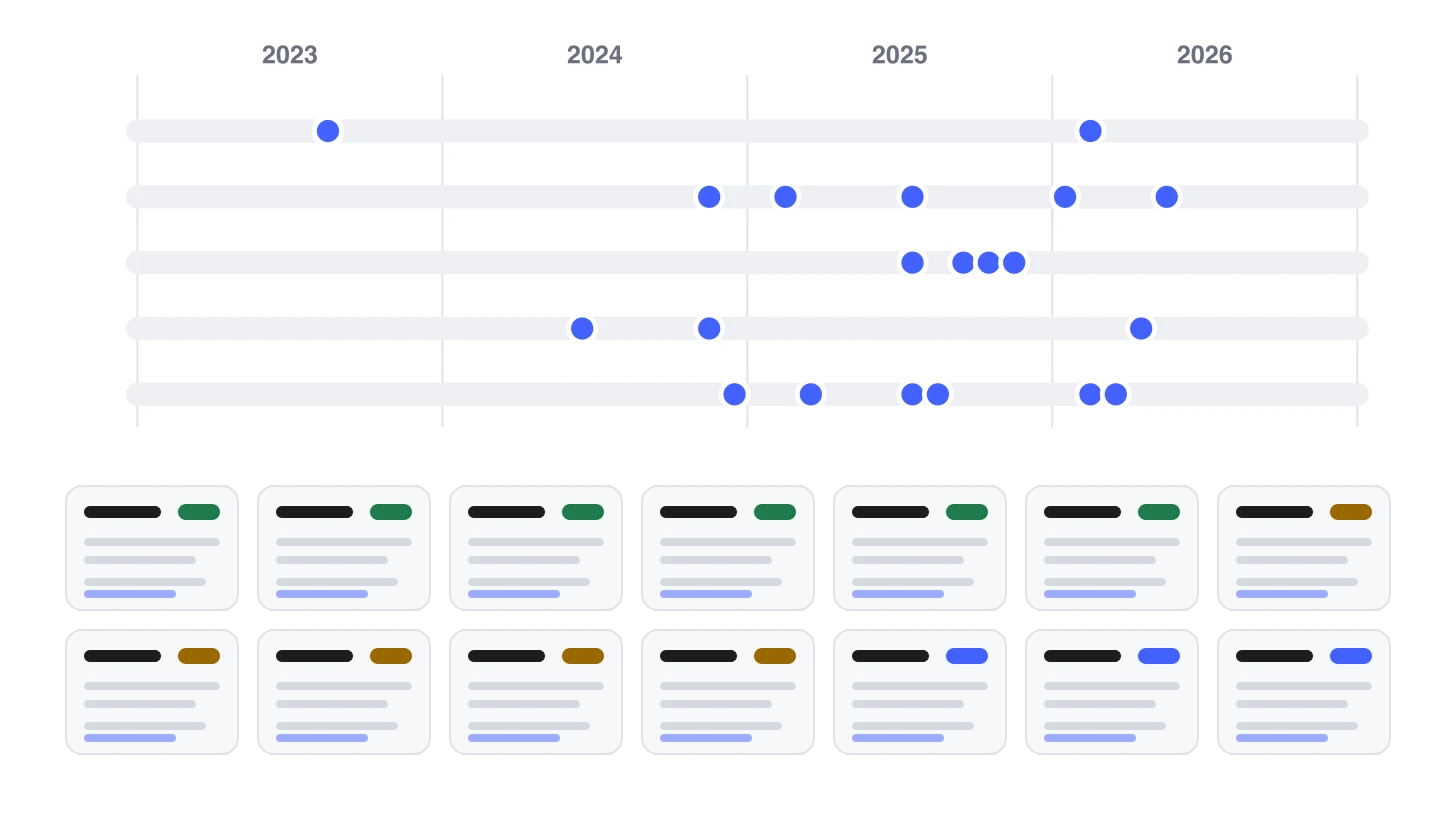
From a paper to products, in three years
From a paper to products, 2023–2026
- Research, standards Inria publishes 3D Gaussian splatting at SIGGRAPH
- Heritage France’s Centre des monuments nationaux ends its tests of splats at the Château d’If and the Hôtel de la Marine
- Film, music, sport Dune: Prophecy airs; Rodeo FX laid out its Imperial Palace as a splat
- Heritage Notre-Dame Immersive, its surrounding city rebuilt with splats, opens in Houston
- Industry, public sector The US Army and USC show large-scale splat terrain for training
- Film, music, sport BAFTA Film Awards: more than 40 winners and presenters captured as splats
- Industry, public sector Volvo Cars and Zenseact use splats to test safety systems
- Film, music, sport Superman is released, with 4D splat holograms
- Real estate, maps Zillow launches SkyTour on its listings
- Industry, public sector DJI Terra 5.0 makes splats from drone surveys
- Industry, public sector NVIDIA announces Omniverse NuRec for robot and vehicle simulation
- Real estate, maps Meta opens Hyperscape Capture on Quest headsets
- Real estate, maps Google Maps shows splat interiors on Android XR
- Real estate, maps Esri adds Gaussian splat layers to ArcGIS
- Film, music, sport A$AP Rocky releases “HELICOPTER”, shot as volumetric splats
- Research, standards Khronos announces the glTF extension for Gaussian splats
- Industry, public sector Seoul police publish a study of splats for crime scenes
- Industry, public sector NuRec becomes generally available; Mcity twins its test track
- Heritage CyArk publishes Pompeii and Civita di Bagnoregio as splats
- Film, music, sport The PGA Championship shows players’ swings in 4D
A timeline of twenty dated events from August 2023 to May 2026, in five lanes: research and standards; film, music and sport; real estate and maps; heritage; industry and the public sector. The same events are listed below the chart in date order, each with its source.
Twenty events, each with its source. Film and heritage were first, from 2024; 2025 brought the big platforms (Zillow, DJI, NVIDIA, Esri, Google); 2026 brought standards and the first sport broadcasts.
Places people visit: real estate, heritage, tourism
Real estate has the largest deployment on record. Zillow’s SkyTour, launched in July 2025, turns the drone footage of a listing into a 3D view you fly around in the browser. Its press release says it is “powered by Gaussian splatting” and presents Zillow as “among the first in the industry to implement and scale” it.
Zillow explaining, in August 2025, how SkyTour turns a listing’s drone footage into a 3D exterior view.
Video: Zillow, on YouTube.Heritage was one of the first sectors to test splats seriously. France’s Centre des monuments nationaux compared them with photogrammetry and NeRF at the Château d’If, the Abbaye de Montmajour and the Hôtel de la Marine between 2023 and 2024. In Notre-Dame Immersive, by Ars Electronica with the French studios Iconem and Histovery, the cathedral is a laser scan but the city around it was rebuilt with splats. And in April 2026 CyArk published Pompeii and Civita di Bagnoregio as splats you visit in the browser, captured with a 360° drone.
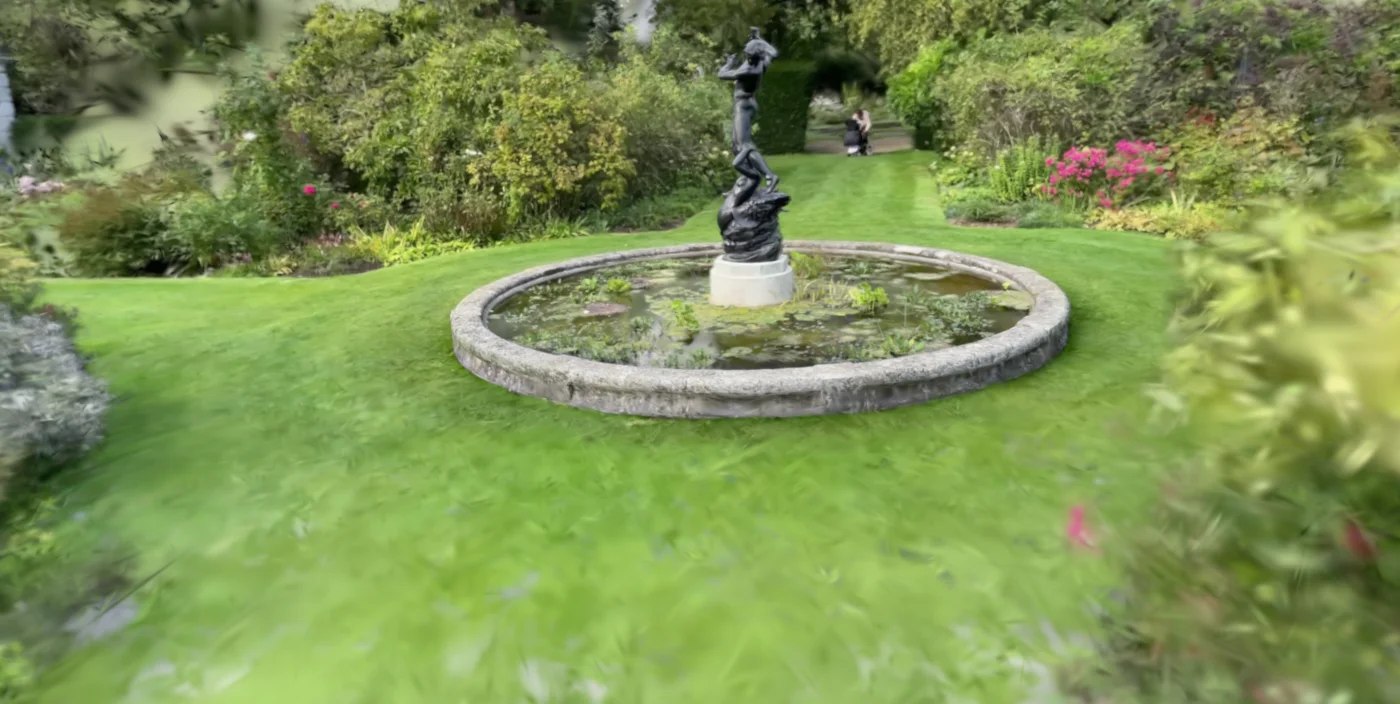
A garden captured as a splat with Polycam, a phone app. Sharp where the camera went, blurred at the edges it never saw. Places people visit are the most natural subject for splats.
Image: Óscar Mirás, CC BY-SA 4.0, via Wikimedia Commons (resized, converted to WebP).Hospitality and tourism are further behind. We found no hotel group, no Airbnb deployment and no tourism board campaign using splats. What exists are indoor scenes of restaurants and cafés in Google Maps Immersive View on Android XR, since October 2025, and virtual-tour tools that have added splats.
On screen: film, advertising, music, media
Film uses splats where other techniques fall short. For Superman (2025), Framestore and Infinite Realities captured actors on a 192-camera stage and played them back as 4D splats for the Kryptonian parents’ holograms, the first use of 4D splats in a feature film. For Dune: Prophecy, Rodeo FX turned its Imperial Palace into a splat of about 18 million Gaussians to lay out shots in real time.
Framestore showing, in February 2026, how the holograms in Superman were captured and rendered as 4D splats.
Video: Framestore, on YouTube.Advertising and music videos follow. A$AP Rocky’s “HELICOPTER”, released in January 2026, was shot by Evercoast on a multi-camera rig. About 10 TB of capture became roughly thirty minutes of splatted footage, edited in Houdini, with no generative AI according to its makers. In Australia, a campaign for The Good Food Guide was made end to end with a 150-camera array. In all these cases the deliverable is an ordinary video: the splat is a production tool, not what viewers receive.
The press is experimenting. The New Yorker published a splat portrait of the artist Lorna Simpson, and the New York Times’ R&D team presented its work on splats for spatial journalism at SIGGRAPH 2025. Sport is testing too: at the 2026 PGA Championship, four players’ swings were captured in 4D on a stage of 56 iPhones.
Sites and machines: construction, maps, vehicles
In construction, surveying and GIS, the tools are in production: DJI Terra since July 2025, Pix4D, Esri since November 2025, Bentley and Cesium, and XGRIDS for Revit. Named contractors or utilities, on the other hand, have published very few cases. AEC Magazine sums it up: splats serve as visual site records, not as a measurement deliverable, which is still the job of scanners and photogrammetry.
DJI presenting Terra 5.0 in July 2025: drone surveys turned into splats, in the same software as the classic maps and models.
Video: DJI Enterprise, on YouTube.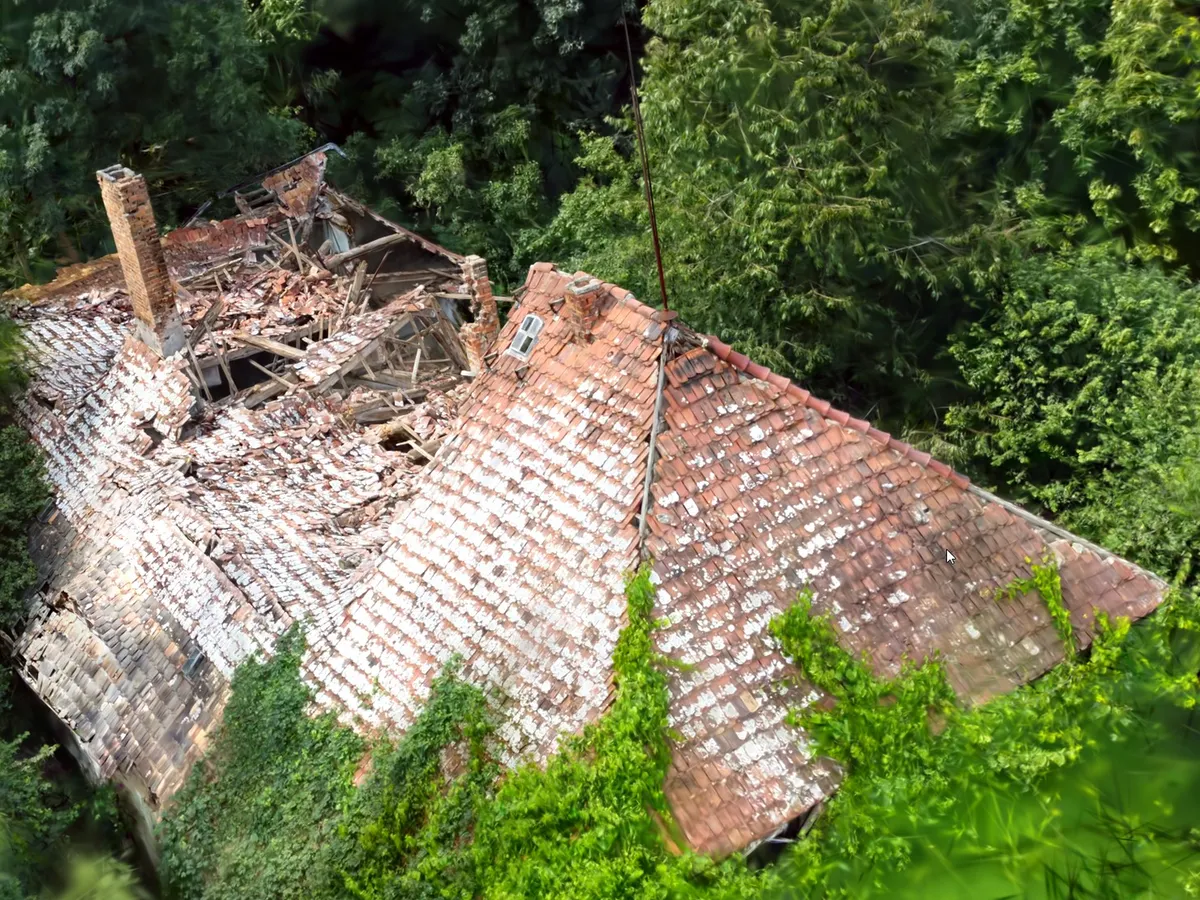
A collapsed house captured as a splat of some twenty million Gaussians: the kind of visual record that construction, insurance and emergency services are testing.
Image: Jurdein, CC BY-SA 4.0, via Wikimedia Commons (cropped to remove the viewer’s panels, resized, converted to WebP).The automotive industry uses splats out of sight, in simulation. Volvo Cars and Zenseact rebuild real incidents from their cars’ sensor data, then vary them thousands of times to test safety systems. NVIDIA’s Omniverse NuRec, generally available since March 2026, is used by Mcity, the University of Michigan’s test track, to make a twin of its site. Waymo offers a counterpoint: its engineers write that purely reconstructed splats “suffer from visual breakdowns” when the simulated car moves away from the path of the original drive.
Still in the lab: health, forensics, training
Three sectors are still at the research stage.
- Forensics. Researchers at Seoul’s police agency and Hongik University reconstructed a mock crime scene with a mean error of 1.7 to 3.6 millimetres. That is promising, but no police force has adopted it yet.
- Healthcare. Many papers, on anatomy from CT scans and on endoscopic surgery, but we found no hospital or medical school using splats.
- Training. Simulators, such as a VR firefighting simulator, are research prototypes.
A few things often presented as splat deployments are not confirmed:
- Apple’s new Flyover in iOS 27 and Google Maps’ aerial views: splats are inferred by the press, not announced.
- Realtor.com’s FlyAround: its press release names Google’s 3D maps, not splats.
- Microsoft’s digital twin of St. Peter’s Basilica: photogrammetry, according to Microsoft.
Is it right for your project?
Is Gaussian splatting right for your project?
- Does what you want to show already exist, physically?
- Must it look exactly like the real thing?
- Will people see it on a screen: a website, a phone, a headset?
- Will you need to change its colours, materials or lighting afterwards?
- Do you need survey-grade measurements from it?
- Is it bigger than a building: a site, a district, a landscape?
A strong fit
A real subject, shown as it is, on screens: exactly what splats do best.
To keep in mind
- Plan a compressed file (SOG, SPZ) and a poster image, sized for phones. The deliverables →
Six yes-or-no questions about a project. The answers give a verdict — a strong fit, a fit with caveats, or probably another technique — and notes that link to the part of the series that explains each point.
Six questions, the same ones we ask at the start of a project. Change an answer to see the verdict and the notes change; each note links to the part of the series that explains it.
At ARGO
The sectors we work in, retail, hospitality, culture and events, media and training, are mostly at the pilot stage. That is a good moment to start. The tools are ready, the file sizes suit phones, and a splat opened from a link or a QR code sets a brand apart before it becomes common. We use splats where they are the right answer, a real place or a real product shown as it is, and we combine them with 3D models, video or augmented reality when a project needs more than that.
FAQ
Frequently asked questions
Sources and further reading
- Real estate and places: Zillow, SkyTour · Unity, Google Maps on Android XR · UploadVR, Meta Hyperscape
- Heritage: Centre des monuments nationaux, CMN Numérique research · Ars Electronica, Notre-Dame Immersive · CyArk, Project ETERNAL
- Film, advertising, media, sport: Framestore, Superman · Rodeo FX at SIGGRAPH 2025 · SideFX, “HELICOPTER” · Radiance Fields, The Good Food Guide and The New Yorker · PGA of America, swings in 4D
- Construction, GIS: AEC Magazine · DJI Terra 5.0 · Esri ArcGIS Reality · Pix4D · Cesium · Khronos, glTF for splats
- Vehicles and robots: Volvo Cars · NVIDIA NuRec · Mcity · Waymo World Model
- Research: Seoul police and Hongik University, crime scenes (Frontiers, 2026) · Anatomy from CT (IEEE TVCG, 2025) · VR firefighting (Remote Sensing, 2024)
Deployments, dates and sources checked on 30 September 2026.